Choosing the Right Purification Strategy for Therapeutic-Grade Antibodies

Choosing the Right Purification Strategy for Therapeutic-Grade Antibodies

Purifying therapeutic-grade antibodies isn’t just a downstream process; it’s key to clinical success. The right purification strategy really affects yield, functionality and the risk of immunogenicity. Recent studies show that better purification helps keep products consistent and speeds up the time to market for biopharmaceutical developers.

Choosing an antibody purification method requires a good mix of purity, recovery and scalability. Chromatography platforms like Protein A affinity are still the go to, but alternatives like mixed-mode and membrane chromatography are popping up for more budget friendly purification. Studies indicate these hybrid methods boost recovery rates and keep therapeutic antibodies structurally intact.

With biopharma pipelines getting more diverse, purification challenges are also changing. High throughput production and strict regulations need customised strategies instead of a one-size-fits-all approach. Recent studies show that adding orthogonal purification steps helps reduce aggregates, which boosts safety and efficacy in clinical grade antibody products.

Want to find out which purification method fits your antibody’s path from lab to patient? Let’s dive into making the right choice.
2 Key Purification Stages in the Antibody Production Workflow

2 Key Purification Stages in the Antibody Production Workflow

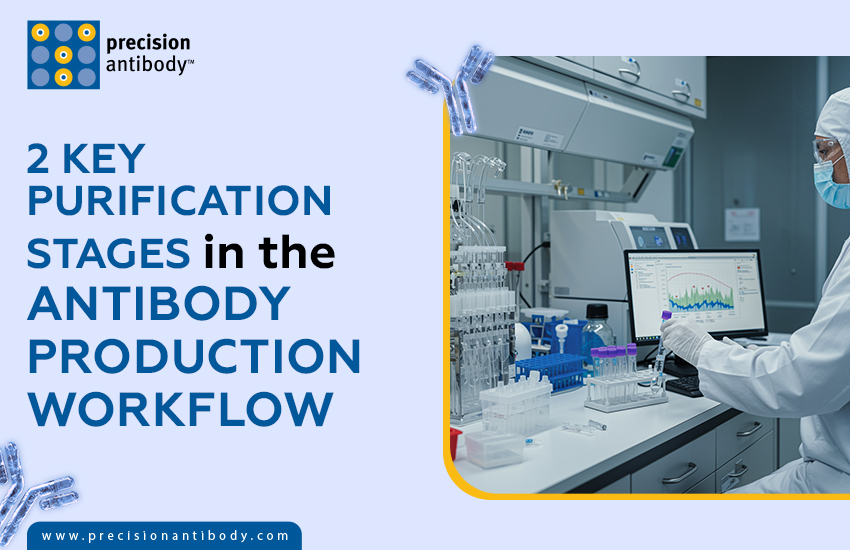
Antibody purification is a step-by-step process aimed at getting therapeutic grade quality. It removes impurities while keeping the biological activity intact. Every phase has a unique role in determining the final product’s stability, potency and how well it works in clinical settings.

Purification generally has two main stages: primary recovery and intermediate or polishing steps. The first one helps capture antibodies efficiently from complex cell cultures and the second one improves purity to meet strict regulatory and safety standards. They really make up the core of a strong downstream process.
1. Primary Recovery

  • This stage is all about separating antibodies from cell debris using centrifugation or filtration and then we use Protein A affinity chromatography for great specificity and purity.
  • When we optimise primary recovery we can achieve over 95% purity and 90% yield. That makes it the most important phase for boosting process efficiency.

2. Intermediate and Polishing Steps

  • There are some techniques like ion exchange, hydrophobic interaction and size exclusion chromatography that help get rid of any leftover impurities, aggregates and charge variants.
  • It turns out that using a mix of different purification steps can really boost the consistency and stability of products especially when it comes to therapeutic uses.

5 Core Purification Strategies for Therapeutic-Grade Antibodies

5 Core Purification Strategies for Therapeutic-Grade Antibodies

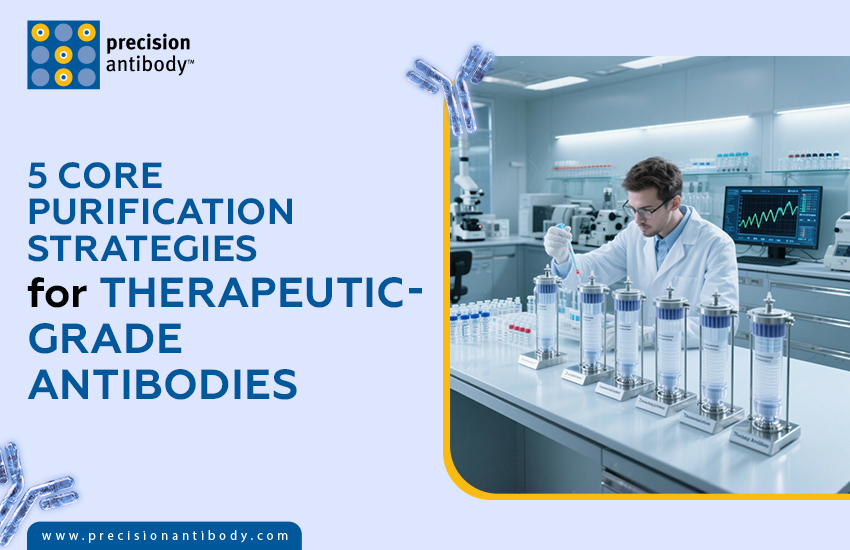
To purify antibodies to therapeutic grade standards you need a mix of techniques that get rid of impurities while keeping the molecular integrity intact. Each method has its own perks in terms of selectivity, scalability and cost-efficiency, depending on the antibody’s traits and how it’s made.

Here are five key strategies that form the core of modern antibody purification workflows. They’re often used together or in hybrid systems to boost yield, purity and functionality in clinical manufacturing pipelines.
1. Protein A Affinity Chromatography

  • Protein A is known as the best for capturing antibodies. It specifically attaches to the Fc region of IgG molecules allowing for high purity recovery in just one step.
  • Studies show over 95% purity and strong scalability making it the go-to first-stage method in research and GMP settings.

2. Ion Exchange Chromatography (IEX)

  • It separates charged impurities and antibody variants with cation or anion exchangers giving you precise control over isoelectric points.
  • Research indicates that IEX boosts charge heterogeneity resolution, leading to better product consistency and regulatory compliance.

3. Hydrophobic Interaction Chromatography (HIC)

  • It takes advantage of small differences in surface hydrophobicity to get rid of aggregates, fragments or misfolded proteins.
  • Using HIC after Protein A or IEX boosts antibody stability and keeps things uniform all without impacting yield.

4. Size Exclusion Chromatography (SEC)

  • It sorts molecules by size to get rid of large aggregates and small contaminants.
  • SEC is an important step for analysing and polishing therapeutic antibodies, making sure they meet high safety and purity standards.

5. Mixed-Mode and Affinity Alternatives

  • Mix ionic, hydrophobic or hydrogen-bonding interactions to enhance selectivity and remove impurities.
  • New research shows that mixed-mode resins can be a cost effective alternative to Protein A especially useful for biosimilars and large-scale production.

Factors to Consider When Choosing a Purification Strategy

Factors to Consider When Choosing a Purification Strategy

Choosing the right purification method isn’t a one-size-fits-all decision. Every antibody candidate has its own set of challenges and the purification method needs to match the molecular behaviour, development goals and manufacturing scale. A good strategy finds the right mix of purity, yield and regulatory readiness while keeping things simple.

These key factors help scientists create efficient and cost effective purification pipelines, ensuring therapeutic grade quality from early discovery to commercial production.
1. Antibody Type and Isotype

  • Different isotypes like IgG, IgM and IgA have unique structures, charges and binding affinities which affect how you choose resins and buffer conditions.
  • Research indicates that Protein A works really well for IgG subclasses but other ligands or mixed mode systems are better for IgM and engineered antibodies.

2. Target Purity and Yield Requirements

  • High-purity applications need different purification steps to get rid of aggregates and charge variants.
  • It’s important to balance purity and yield if conditions are too strict, it can lower recovery and impact downstream functionality.

3. Scale and Production Stage

  • In the early research stages, smaller, more flexible systems might be better but for clinical manufacturing we need high-throughput, automated platforms.
  • Continuous chromatography and single-use systems make antibody purification scalable and contamination free.

4. Cost, Throughput, and Resin Lifetime

  • The performance and reusability of resin really impact production costs, especially when dealing with large volumes.
  • Studies on process optimization show that using high-capacity resins can help columns last longer and lower purification costs for each gramme of antibody.

5. Regulatory and Quality Standards

  • Purification processes need to follow cGMP and ICH guidelines to make sure batches are consistent and traceable.
  • Using validated and reproducible purification workflows makes regulatory approval easier and ensures therapeutic reliability.

3 Common Pitfalls in Antibody Purification That Should Be Avoided

3 Common Pitfalls in Antibody Purification That Should Be Avoided

Even the best purification workflows can stumble if key process variables are missed. Common mistakes usually come from being too confident in familiar methods or hurrying through development without checking feasibility first. Any mistake can affect the integrity, yield or quality of the antibodies.

Spotting these issues early helps scientists create strong, scalable and compliant purification strategies that cut down on rework and guarantee steady therapeutic results.
  • Over-Reliance on Protein A
  • Ignoring Aggregation and Leaching
  • Skipping Small-Scale Feasibility Studies

How Precision Antibody Optimizes Therapeutic-Grade Purification

How Precision Antibody Optimizes Therapeutic-Grade Purification

At Precision Antibody, we design each purification strategy to ensure that you get clinical-grade antibodies that stand out in terms of purity, yield and consistency. Our scientists use data-driven insights, advanced chromatography platforms and strict quality controls to make sure every molecule meets top therapeutic standards.

  • Expertise in Multi-Step Chromatography Design
  • GMP-Aligned Quality Systems
  • Tailored Purification for Complex Antibody Formats

Work with Precision Antibody to get purification expertise that speeds up your journey from discovery to clinical development. Contact our team today and find out how our personalised purifying solutions will help you make your next medical breakthrough.

Frequently Asked Questions (FAQs)

Q1: How to choose the correct antibody?

The right antibody for your study or treatment depends on your goals. Consider factors like the antigen’s specificity, isotype, host species and your intended use whether it’s for diagnostic, therapeutic or analytical purposes. For developing therapies, it’s best to use fully human or humanised antibodies. They help lower immunogenicity risks and boost clinical effectiveness.

Q2: How will you determine if your purification is successful?

We measure purification success with techniques like SDS-PAGE, HPLC and size-exclusion chromatography to ensure purity, consistency and check for aggregates. A solid process gets high recovery rates, keeps purity levels over 95% and makes sure the antibodies stay functional in various validation batches.

Q3: What can go wrong in protein purification?

When dealing with proteins, you might run into issues like clumping, column blockages or resin leaks. These can lower your yields or alter antibody structures. Not optimising buffers or skipping preliminary tests can seriously hurt the reliability of the process affecting both efficiency and the quality of the final product.
Precision Antibody

Led by innovative minds in immunology and the antibody development field, Precision Antibody has been an industry leader for over 20 years. We not only implement a cutting-edge technique in antigen design, antibody development, production, and other analyses, but we are also constantly working on ways to improve and advance technology to match the ever-changing world of science. If you are interested in learning more about Precision Antibody’s Custom Antibody development.

Contact us today!

Popup Image