
Antibody purification is not a single action but a sequence of intentional steps, each solving a different problem. Capture and polishing stages are often mentioned together, yet they serve different purposes and influence product quality in other ways as well as downstream research or development outcomes reliability backstage.
During the capture step, the priority is speed and selectivity, pulling the target antibody out of a complex mixture early in the process. This step removes large impurities, stabilizes the molecule, and lays the foundation for purification decisions and performance expectations throughout the development pipeline.
Later polishing steps refine rather than recover. Closely similar contaminants, aggregates, and variants are removed to enhance purity, consistency, and safety, ensuring that the antibody meets strict functional and regulatory requirements before its clinical and research applications.
To avoid difficulties and quality trade-offs further down the line, one should distinguish between capture and polishing. Discover how optimizing both capture and polishing can transform antibody quality see how Precision Antibody makes it happen.
Antibody yield, purity, and consistency depend on purification strategy. The decision made during the capture and polishing influences recovery rates, impurity profiles and structure. A harmonized balance between efficiency and control ensures that your antibodies perform reliably across assays, studies, and long-term development programs.
Purification choices have essential implications spanning from regulatory scrutiny to experimental reproducibility. Unplanned steps can introduce variability, hidden contaminants, or downstream aggregation. If we don’t plan well, it can lead to validation issues, delays in approval, or loss of confidence in the results. That’s why it is vital to begin purification design as early as possible.
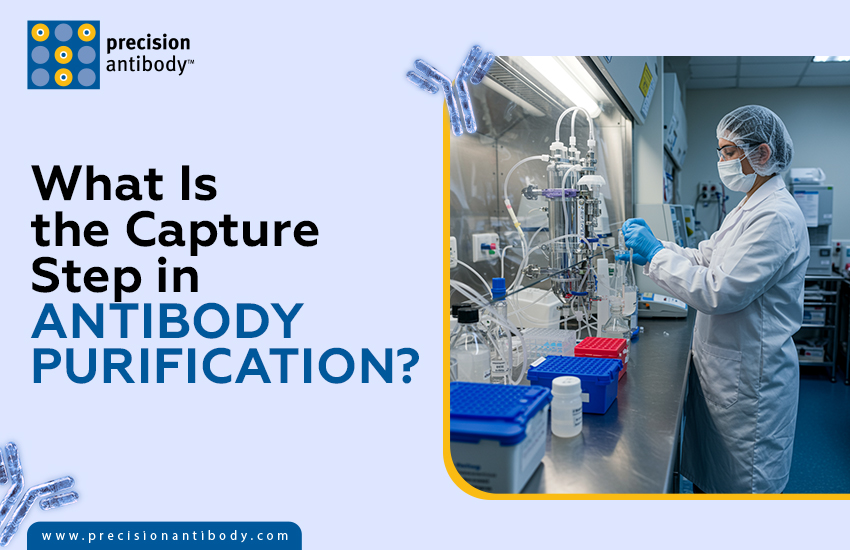
The capture step is the first significant purification step, in which the antibody of interest is separated from a complex mixture such as cell culture supernatant or serum. This step is essential because the binding is rapid and highly selective, so the antibody can be concentrated whilst large quantities of host cell proteins and debris are removed.
Capture reduces early sample complexity and stabilizes the antibody while protecting its functionality for downstream operations. Processes like affinity chromatography are commonly used here to ensure good recovery and a consistent platform for subsequent polishing steps that enhance purity and quality.
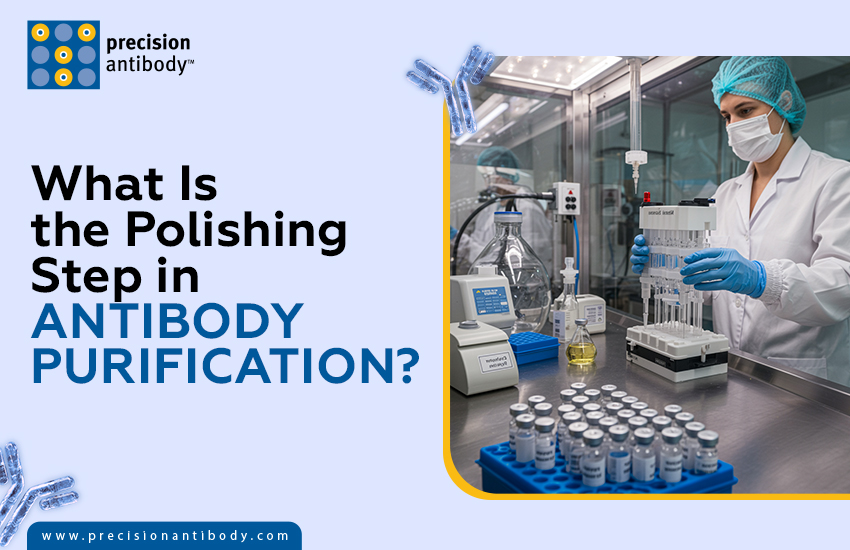
After capture, there is a polishing step directed towards final purification of the antibody rather than final bulk recovery. By this stage, various significant contaminants have already been removed. Therefore, separation methods can focus on removing closely related impurities such as aggregates, fragments, charge variants, and residual host cell proteins.
It is a necessary step to ensure consistency, safety, and functional quality. Polishing enhances the antibody’s purification profile, helping ensure the final product performs as expected in sensitive assays, reproducible research, and regulatory requirements. In doing so, the risk of downstream failures or unforeseen variability is mitigated.
Capture and polishing, while both part of the same purification workflow, do very different things. Capture concentrates on quick separation and recovery, whilst polishing emphasises refinement and control. By recognizing the distinctions among these stages, teams can create balanced strategies that protect yield, purity, and antibody activity afterwards.
| Aspect | Capture Step | Polishing Step |
|---|---|---|
| Primary goal | Rapidly isolate and concentrate the target antibody | Remove closely related impurities and variants |
| Stage in workflow | First major purification step | Later, refinement-focused stage |
| Selectivity focus | High selectivity for the target from complex mixtures | Fine discrimination between similar molecules |
| Impact on yield | Maximizes recovery early in the process | Often trades some yield for higher purity |
| Quality contribution | Reduces bulk contaminants and stabilizes antibody | Ensures consistency, safety, and regulatory readiness |
When capture and polishing steps are designed to work together, they give optimum results. With a good capture step, the mixture becomes simpler and the antibody is sheltered, allowing the polishing steps to operate with improved precision, efficiency, and control, while mitigating direct trade-offs between yield, purity and consistency.

Designing an effective antibody purification strategy requires more than selecting individual techniques; it demands an integrated view of capture, polishing, and downstream performance. Precision Antibody aligns purification choices with molecule-specific performance, study goals, and long-term quality expectations from early development onward.
An effective purification strategy saves time and resources while protecting data quality. Get in touch with Precision Antibody to design a purification strategy that delivers dependable outcomes and enables secure advancement throughout the process.
Q1: Can capture and polishing conditions affect antibody stability?
Certainly, the conditions utilized during both the capture and polishing steps greatly impact the antibody’s stability. Harsh conditions of binding, elution or buffers may cause aggregation or structural change. With optimized parameters, the conformational integrity is maintained early enough so that stability issues do not arise later during purification or downstream.
Q2: Is it better to optimize capture or polishing first when facing purity issues?
In most situations, it is preferable to optimize the capture step first as this defines the impurity load entering polishing. A poorly designed capture stage may overload polishing steps limiting effectiveness. When your capture is sufficiently strong, you can download fine tuning to tackle close relatives.
Q3: How does outsourcing purification strategy development benefit antibody programs?
Outsourcing allows a company to access expertise, processes and tools without taxing internal resources. When collaborating with experienced partners, issues related to purification can be anticipated; the time-consuming trial-and-error process can be mitigated; and balanced strategies constructed that enhance consistency, efficiency and progression (from research to development).